
Bengaluru Doctor Spent 17 Years Building a Mobility Device for Paralysis Patients
After 17 years of research, Bengaluru doctor Dr Parag Gad developed xStep, a non-surgical mobility device designed to help people with paralysis and cerebral palsy.
Abhinav Kumar
6/13/2026
Bengaluru Doctor Spent 17 Years Building a Mobility Device for Paralysis Patients
For many people living with paralysis, progress is often measured in moments that others might overlook: a finger moving, a foot responding, a hand gripping again.
For Bengaluru-based physician and researcher Dr Parag Gad, helping patients reclaim those moments became a mission that lasted nearly two decades.
After 17 years of research, experimentation, and development, he introduced xStep, a non-surgical mobility device designed to support rehabilitation for people with paralysis and cerebral palsy. What began as an academic research project has evolved into a technology that is now drawing attention from rehabilitation specialists, patients, and investors alike.
A Problem That Affects Millions
Paralysis and cerebral palsy affect millions of people worldwide.
Spinal cord injuries can disrupt communication between the brain and muscles, making even simple movements difficult or impossible. Cerebral palsy, a neurological condition that affects movement and posture, impacts millions of children globally and often requires years of therapy and support.
Traditional rehabilitation can improve quality of life, but it is often expensive, time-consuming, and physically demanding. Surgical interventions, implants, and recurring treatments may also place financial and emotional burdens on families.
It was within this challenge that Dr Gad began asking a different question: could technology help restore movement without surgery?
From Research Lab to Long-Term Mission
The story of xStep did not begin in a startup incubator or corporate research center.
According to reports, the idea emerged during Dr Gad's doctoral research at the University of California, Los Angeles (UCLA), where he explored how the nervous system coordinates movement. Over time, his research focused on the communication network between the brain, spinal cord, nerves, and muscles.
The central insight behind the project was relatively straightforward.
Movement is not controlled by the brain alone. It depends on continuous signals traveling through the nervous system. When those signals are interrupted because of injury or neurological conditions, muscles may still exist and remain capable of activation, but the communication pathway becomes impaired.
Dr Gad's work explored whether carefully delivered electrical stimulation could help activate these pathways during rehabilitation.
Turning that idea into a usable medical device, however, required years of testing, refinement, and persistence.
What Is xStep?
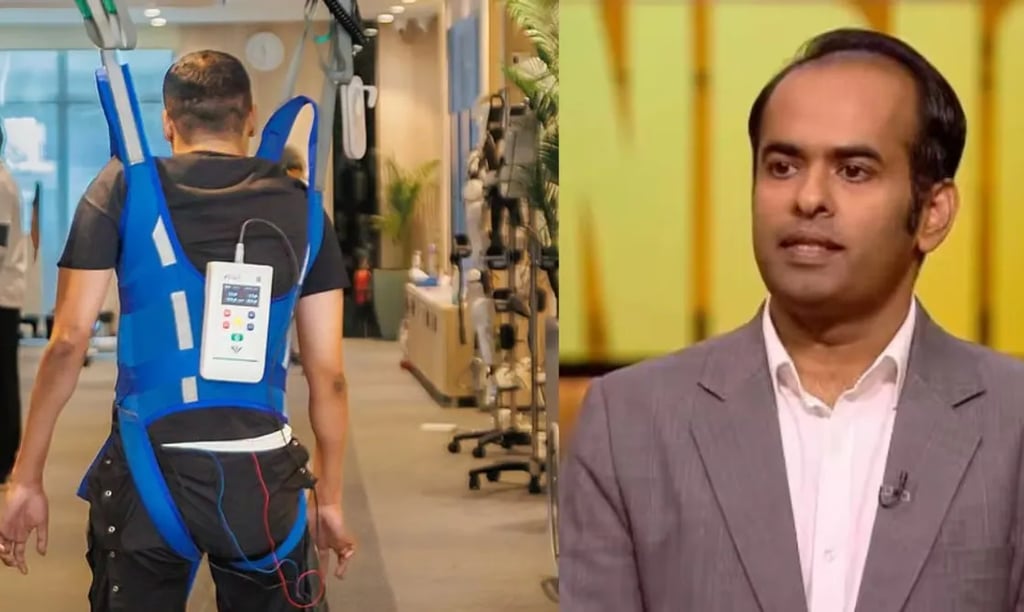
xStep is an external rehabilitation device that uses mild electrical stimulation to activate nerves and muscles during therapy sessions.
Unlike invasive treatments that require surgery or implanted hardware, the device is worn outside the body. During rehabilitation exercises, it delivers carefully controlled electrical pulses intended to support movement and neuromuscular coordination.
The goal is not simply to move a limb mechanically.
The technology seeks to encourage communication between different parts of the nervous system while a patient is actively engaged in rehabilitation.
According to reports cited by The Better India and other publications, some users have shown visible movement during therapy sessions, while certain patients reportedly experienced noticeable responses within minutes of stimulation. Researchers and clinicians continue to evaluate the long-term impact of such interventions.
Returning to India
After spending years abroad conducting research and development, Dr Gad returned to India in 2023.
He later established his company, Vivatronix, to manufacture and scale the technology within the country. The move reflected a broader ambition: making advanced rehabilitation technology more accessible to Indian patients and rehabilitation centers.
India faces a significant gap in rehabilitation infrastructure. Access to specialized neurological rehabilitation remains concentrated in major urban centers, while many patients in smaller cities and rural regions struggle to obtain consistent care.
Affordable rehabilitation technologies could play an important role in reducing that gap.
National Attention on Shark Tank India
The device gained wider public visibility when Dr Gad appeared on Shark Tank India Season 5.
During his presentation, he shared stories of children and adults living with severe movement limitations and demonstrated the device's functionality before the investors. The demonstration generated significant interest, particularly when panel members observed involuntary muscle activation during testing.
The presentation concluded with an investment deal from multiple investors, providing funding intended to expand manufacturing and accessibility.
While television exposure brought public attention, the larger significance lay elsewhere.
For many viewers, it was one of the few times rehabilitation technology occupied center stage in a mainstream business program.
Why Rehabilitation Innovation Matters
Medical innovation often focuses on curing disease.
Rehabilitation innovation focuses on living with it.
For individuals with paralysis, recovery is rarely a single event. It is usually a long process involving therapy, adaptation, and repeated effort. Technologies that improve mobility, independence, or quality of life can have profound effects even when they do not constitute a complete cure.
Globally, researchers are exploring multiple approaches, including robotic exoskeletons, spinal stimulation systems, brain-computer interfaces, and neurorehabilitation devices. xStep belongs to this broader movement seeking ways to restore function through neuroscience and rehabilitation engineering.
The field remains complex, and outcomes vary from patient to patient. Experts generally emphasize that such technologies should complement professional rehabilitation programs rather than replace them.
Beyond Technology: The Human Dimension
The most compelling aspect of this story is not the device itself.
It is the timeframe.
Seventeen years is long enough for trends to change, startups to rise and disappear, and entire industries to transform. Yet the project continued.
Behind every rehabilitation device are families hoping for greater independence, caregivers seeking better outcomes, and patients trying to regain control over daily life.
For them, progress is often measured not in headlines but in small victories.
A hand that can hold a spoon.
A child who can stand more confidently.
A patient who takes a step that once seemed impossible.
Conclusion
The story of the xStep mobility device is ultimately about persistence in medical innovation.
Dr Parag Gad's 17-year effort reflects the slow and often uncertain path that many healthcare breakthroughs follow. Whether xStep reaches millions of patients in the years ahead will depend on continued clinical validation, accessibility, and adoption within rehabilitation systems.
But its development already highlights an important reality: meaningful innovation is not always about creating something entirely new. Sometimes it is about spending years solving a problem that affects people's dignity, independence, and ability to participate fully in everyday life.
Related Stories
The Divine Duty © 2026
The Divine Duty shares inspiring stories, cultural heritage, documentaries, change makers, and human journeys that educate, preserve, and inspire.