
Jharkhand Engineer Quits Corporate Job to Weave Water Hyacinth Sarees
Discover how Gaurav Anand left his corporate career in Jharkhand to restore rivers and transform an invasive aquatic weed into water hyacinth sarees.
Abhinav Kumar
6/10/2026
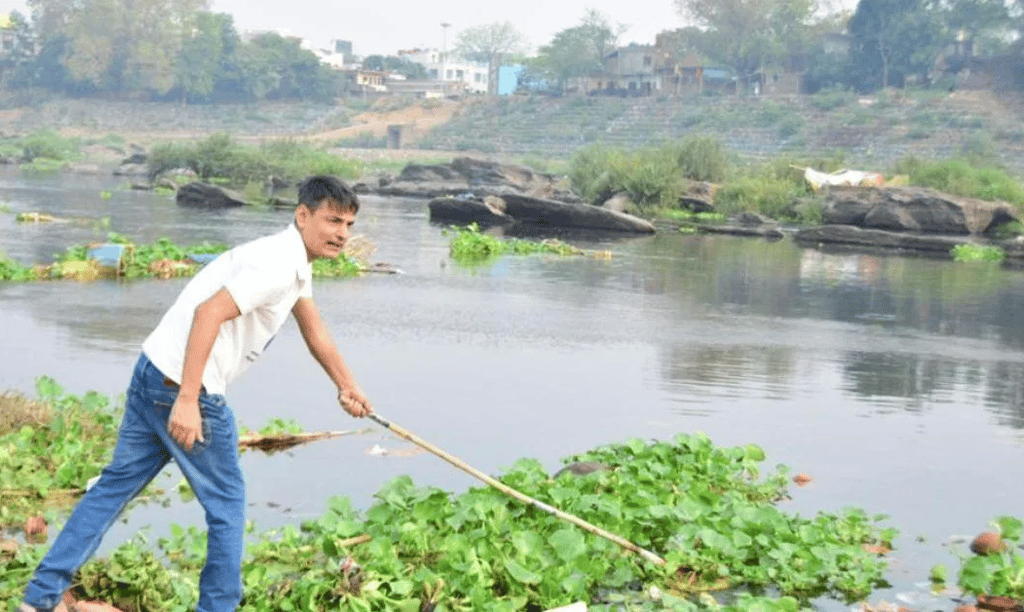
Gaurav identified this big abnormality in the river in the form of water hyacinths during the river cleaning drives.
Jharkhand Engineer Quits Corporate Job to Weave Water Hyacinth Sarees
The rivers of eastern India are quietly suffocating under a thick blanket of green. Yet inside a workshop in Jharkhand, this exact ecological threat is being spun into something beautiful and economically vital. Gaurav Anand, a 46-year-old former environmental engineer, has successfully engineered a method to transform a destructive aquatic plant into high-quality water hyacinth sarees. His initiative has not only cleared vital waterways but also created stable livelihoods for more than 450 rural women and traditional weavers.
The River Expedition
For sixteen years, Gaurav built a comfortable life working in a corporate role for the Tata Group in Jamshedpur. His trajectory shifted permanently in 2018. That year, he participated in a month-long river rafting expedition to clean the Ganga. Surrounded by fellow volunteers and environmentalists, he witnessed firsthand the severe degradation of India's rivers.
When the mission ended and others returned to their daily routines, Gaurav found he could not go back to business as usual. He began dedicating his weekends to cleaning the Swarnarekha river in his home state. By 2022, he realized a part-time effort was not enough. He resigned from his corporate position and founded the Swachhata Pukare Foundation to focus entirely on river conservation.
The Terror of Bengal
During his weekend cleaning drives, Gaurav repeatedly encountered one persistent enemy: Pontederia crassipes, commonly known as water hyacinth. Native to South America, this free-floating perennial plant multiplies at an alarming rate. In India, it is often called the "Terror of Bengal" due to its aggressive spread across ponds, lakes, and slow-moving rivers.
The weed forms a dense canopy across the water surface. This blocks vital sunlight from reaching submerged plants and drastically reduces dissolved oxygen levels. Aquatic life requires at least five milligrams of dissolved oxygen per litre to survive, but a heavy hyacinth infestation can drop that level to just one milligram, effectively killing fish and destroying the local ecosystem.
Gaurav realized that manually pulling the weed out of the water was only half the battle. They needed a sustainable way to dispose of the massive amounts of biomass they were collecting.
Weaving Water Hyacinth Sarees
Drawing on his engineering background, Gaurav studied the chemical composition of the water hyacinth. He discovered that its pulp is rich in cellulose, the exact structural component needed to create durable natural fibers like jute or cotton.
The manufacturing process developed by his team requires immense patience. First, rural workers harvest the weed directly from the choked rivers. The leaves and stems are separated, and the stems are left to dry under the sun for a full week. Once dried, the material undergoes a hot water treatment to eliminate insects and impurities. A specialized machine then extracts the fibrous pulp, which is spun into a strong, natural yarn.
Because pure hyacinth fiber can be slightly brittle on its own, Gaurav decided to fuse it with cotton to ensure longevity. The final product is a handloom saree made from a blend of 25 percent water hyacinth and 75 percent cotton. It takes roughly 25 kilograms of the raw aquatic weed to produce enough fiber for a single garment.
Reviving Livelihoods
While the environmental impact is significant, the human impact is equally profound. To weave the colored yarn into fabric, Gaurav partnered with ten families of traditional weavers in Santipur, a village in West Bengal renowned for its handloom heritage. Many of these artisans were on the verge of abandoning their craft due to dwindling incomes. The steady supply of hyacinth yarn has revitalized their looms, allowing them to continue their generational trade.
Simultaneously, the project employs around 450 rural and tribal women in Jharkhand to harvest and process the plants. These women, many of whom previously worked in hazardous industries, now earn between 5,000 and 12,000 rupees a month working in safe, flexible conditions. They take the raw materials home, process them, and build a reliable income that grants them financial independence.
A Model for Circular Economy
The water hyacinth sarees are now sold across India and exported to international markets like France and Italy. Priced affordably for middle-income buyers, the garments represent a perfect loop of ecological restoration and economic production. No synthetic dyes or harmful chemicals are used in the process, ensuring the entire lifecycle of the product respects the earth.
Gaurav is currently exploring ways to increase the hyacinth ratio in the fabric to 50 percent, pushing the boundaries of sustainable textile engineering. His foundation also uses the remaining parts of the plant to craft handmade paper, notebooks, and lampshades, ensuring zero waste.
Looking Forward
By reimagining an environmental crisis as an untapped resource, this initiative offers a practical blueprint for conservation. It proves that restoring nature does not have to be an act of charity. It can be a functioning, profitable enterprise that respects both the environment and human dignity. For Gaurav, leaving a lucrative career to wade into choked rivers has provided something a salary never could. He has found a way to heal the waters of his home while weaving a better future for hundreds of families.
Related Stories
The Divine Duty © 2026
The Divine Duty shares inspiring stories, cultural heritage, documentaries, change makers, and human journeys that educate, preserve, and inspire.