
Karnataka's Women-Led Industrial Park Opens New Doors for Women Entrepreneurs
Karnataka's women-led industrial park in Gauribidanur aims to help women entrepreneurs enter manufacturing, create jobs, and build scalable businesses.
Abhinav Kumar
6/13/2026
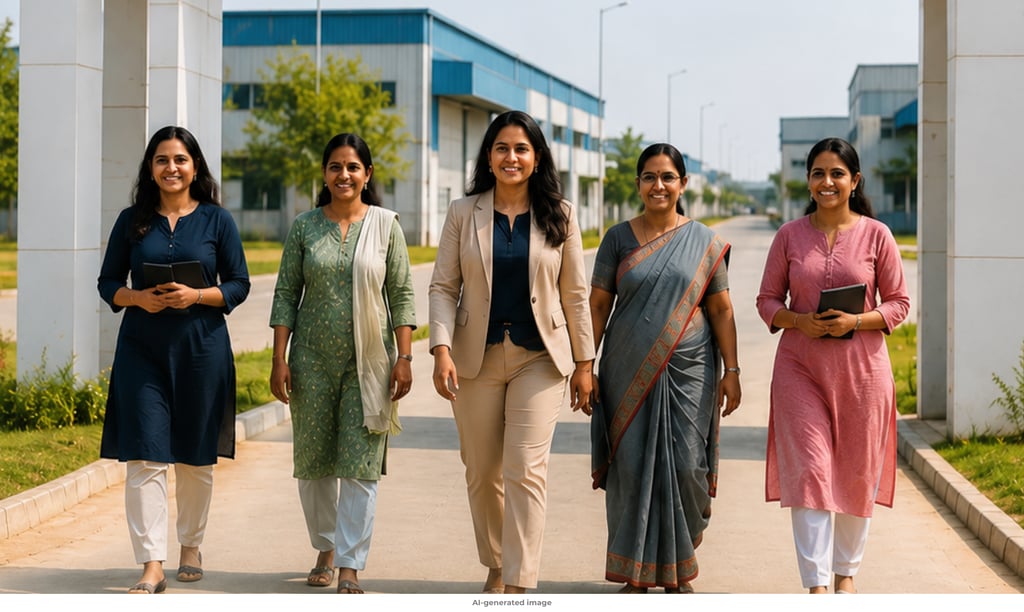
Karnataka's Women-Led Industrial Park Opens New Doors for Women Entrepreneurs
For many women entrepreneurs in India, starting a business is difficult. Scaling it into a manufacturing enterprise is often even harder.
Access to industrial land, factory infrastructure, financing networks, and business ecosystems has traditionally favored larger and more established players, most of whom have been men.
A newly inaugurated women-led industrial park in Karnataka is attempting to change that reality.
Located in Gauribidanur, about 75 kilometres from Bengaluru, the 50-acre industrial park has been designed specifically to help women entrepreneurs establish and grow manufacturing businesses while creating employment opportunities in the region.
A Different Kind of Industrial Development
Industrial parks are not new to India.
Across the country, governments have established special industrial zones to attract investment, boost manufacturing, and generate employment.
What makes this project different is its focus.
The Gauribidanur industrial park has been developed as a women-led initiative, with the goal of reducing barriers that often prevent women from entering manufacturing and industrial sectors. The project was inaugurated by FICCI Ladies Organisation (FLO) Bengaluru, the women's wing of the Federation of Indian Chambers of Commerce and Industry (FICCI).
While women-owned businesses have grown significantly across India in recent years, many remain concentrated in service sectors, home enterprises, retail, and small-scale operations.
Manufacturing presents a different challenge.
It requires land, machinery, compliance approvals, logistics, skilled labor, and larger investments.
The industrial park seeks to provide an ecosystem where women entrepreneurs can access these opportunities in a more supportive environment.
Why Manufacturing Matters
When discussions about entrepreneurship emerge, technology startups often dominate headlines.
Yet manufacturing remains one of the strongest drivers of large-scale employment.
A successful factory does more than produce goods.
It creates jobs for machine operators, technicians, supervisors, transport workers, suppliers, packaging vendors, and local service providers.
For many communities, a single manufacturing unit can generate economic activity far beyond its factory walls.
That is why the significance of this women-led industrial park extends beyond entrepreneurship.
It is also a story about employment creation.
As businesses establish operations within the park, the surrounding region could benefit from new jobs, local procurement opportunities, and increased economic activity.
The Challenge Women Entrepreneurs Often Face
Across India, women are increasingly starting businesses.
However, several studies have highlighted persistent obstacles.
Access to capital remains uneven. Property ownership, which is often used as collateral for loans, is lower among women. Business networks can be harder to access. Manufacturing sectors frequently remain male-dominated, creating additional challenges for first-generation entrepreneurs.
These barriers are not always visible.
A woman may have a viable product, a strong business idea, and market demand, yet still struggle to secure industrial space or navigate the systems needed to establish a manufacturing operation.
The industrial park aims to address some of these structural challenges by creating a community where women business owners can learn, collaborate, and grow alongside one another.
Why Gauribidanur Matters
The choice of Gauribidanur is significant.
Located in Karnataka's Chikkaballapur district, the town sits close enough to Bengaluru to benefit from connectivity and industrial opportunities while also providing room for future growth.
For smaller cities and towns, industrial investments often bring ripple effects.
New businesses create demand for transportation, warehousing, housing, food services, maintenance work, and local suppliers.
As a result, economic benefits frequently extend beyond the entrepreneurs operating inside the industrial park.
This can be particularly meaningful for women seeking employment opportunities closer to home.
A Broader Shift in Women's Economic Participation
The launch of the women-led industrial park is part of a larger shift taking place across India.
In recent years, governments, business associations, self-help groups, and private organizations have introduced initiatives aimed at increasing women's participation in the economy.
From women-run cafes and self-help group enterprises to dedicated business networks and entrepreneurship programs, efforts are expanding to support women beyond traditional sectors.
The industrial park represents a more ambitious step within that movement.
Rather than supporting women after a business has already been established, it seeks to provide infrastructure that can help businesses emerge and scale from the beginning.
That distinction matters.
Economic participation becomes more meaningful when women are not only workers but also business owners, employers, manufacturers, and investors.
Beyond Infrastructure
Buildings and industrial plots alone do not create successful businesses.
Entrepreneurship depends on mentorship, networks, market access, financing, and long-term support.
Organizations behind the project have emphasized collaboration, community building, and creating opportunities for women entrepreneurs to connect with one another.
This approach recognizes an important reality.
Many successful business ecosystems are built not just on infrastructure but on relationships, shared learning, and collective growth.
If the industrial park succeeds, its impact may ultimately be measured not by the number of acres it occupies, but by the number of sustainable businesses that emerge from it.
Why This Story Matters
Development stories are often discussed through large numbers: investments announced, acres allocated, or projects inaugurated.
But their true significance becomes visible when people begin using them.
A first-generation entrepreneur opening her first factory.
A local woman securing stable employment.
A family gaining economic security through work created by a nearby enterprise.
Those outcomes are harder to measure, but they are often the most meaningful.
Conclusion
The women-led industrial park in Karnataka is more than a new industrial development.
It represents an attempt to widen participation in a part of the economy where women have historically been underrepresented.
Whether it becomes a national model will depend on the businesses it helps create, the jobs it generates, and the entrepreneurs it empowers over the coming years.
For now, it offers something that many aspiring entrepreneurs need before capital, machinery, or infrastructure: a place to begin.
Related Stories
The Divine Duty © 2026
The Divine Duty shares inspiring stories, cultural heritage, documentaries, change makers, and human journeys that educate, preserve, and inspire.