
The ₹2 Doctor Couple Who Chose a Remote Village and Stayed for Four Decades
For nearly 40 years, Dr. Ravindra and Dr. Smita Kolhe served a remote tribal village in Maharashtra, charging just ₹2 while transforming rural healthcare.
Abhinav Kumar
6/13/2026
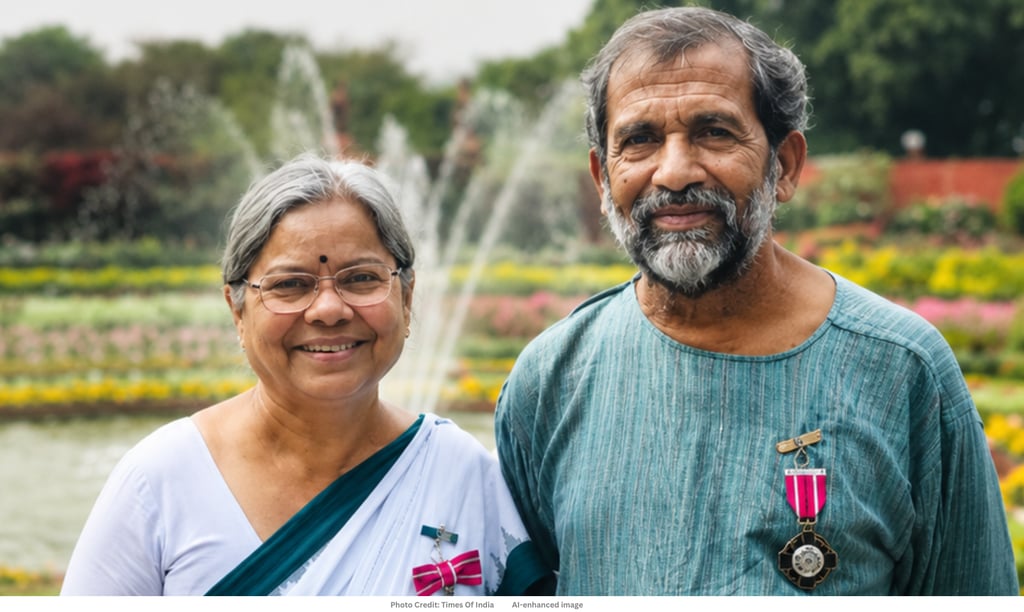
The ₹2 Doctor Couple Who Chose a Remote Village and Stayed for Four Decades
In an age when healthcare is often discussed through technology, hospitals, and rising costs, one of India's most influential public health stories began with a consultation fee of just ₹2.
Nearly four decades ago, Dr. Ravindra Kolhe arrived in a remote tribal village in Maharashtra's Melghat region. The village had little infrastructure, poor connectivity, and limited access to healthcare. Most doctors would have considered it an impossible place to build a career.
Instead, he chose to build a life there.
Years later, his wife, Dr. Smita Kolhe, joined him. Together, they became known as the ₹2 doctor couple, dedicating their lives to serving one of India's most underserved communities.
A Village at the Edge of the Map
The story begins in Bairagarh, a tribal village in the Melghat region of Maharashtra.
When Dr. Ravindra Kolhe first arrived in 1985, reaching the village itself was a challenge. Roads ended far away, and visitors often had to walk nearly 40 kilometres through forest terrain to reach the settlement. Healthcare facilities were virtually absent. Electricity was limited. Infant deaths were common. Malnutrition and preventable diseases affected entire communities.
Fresh out of medical school, Dr. Kolhe could have pursued a conventional career in a city.
Instead, he chose Melghat.
His consultation fee was fixed at ₹2 for a first visit and ₹1 for follow-up care, not as a symbolic gesture but because most villagers simply could not afford more.
The Conditions He Set for Marriage
The decision to serve a remote village was not a temporary experiment.
Dr. Kolhe intended it to be a lifelong commitment.
When the time came to marry, he reportedly had unusual expectations. He wanted a partner willing to live in a remote village, survive on a modest income, walk long distances when necessary, and dedicate herself to serving others. According to accounts of his life, he even said his future wife should be prepared to "beg" if it helped improve the lives of villagers.
That partner turned out to be Dr. Smita Manjare, later known as Dr. Smita Kolhe.
She was a trained medical practitioner herself and chose to leave behind the comfort of urban life to join him in Bairagarh.
The village gained not one doctor, but two.
More Than a Medical Practice
The Kolhes quickly discovered that medicine alone could not solve Melghat's problems.
Patients were arriving with illnesses linked to malnutrition, poor sanitation, unsafe childbirth practices, and lack of basic infrastructure.
Treating symptoms was not enough.
The causes had to be addressed.
Over the years, the couple became involved in issues far beyond healthcare. They worked on nutrition awareness, maternal health, public distribution systems, access to government schemes, and community education. They advocated for roads, connectivity, and public services that many urban residents take for granted.
Their work gradually shifted from treating individual patients to improving the conditions that made people sick in the first place.
When the Village Became Family
One incident became particularly significant.
According to documented accounts, when the Kolhes' infant child became critically ill with severe infections, they had the option of seeking advanced treatment elsewhere. Instead, they chose to continue treatment within the same resource-constrained environment where local families received care.
The decision resonated deeply with villagers.
For years, rural communities across India had watched outsiders arrive, work briefly, and leave.
The Kolhes stayed.
More importantly, they accepted the same hardships experienced by the people they served.
Trust grew.
And in public health, trust can be as important as medicine.
Measuring Impact Beyond Numbers
The most meaningful changes rarely happen overnight.
Over decades, however, improvements became visible.
Research and documented accounts attribute significant reductions in infant and child mortality within the region to sustained public health interventions, improved awareness, and better access to care. The Kolhes' work became widely recognized as a model of community-centered healthcare.
Their approach challenged a common assumption about healthcare delivery.
Many solutions focus on bringing patients to healthcare systems.
The Kolhes brought healthcare to patients.
Instead of asking vulnerable communities to overcome impossible barriers, they embedded themselves within those communities and worked alongside them.
National Recognition After Years of Quiet Service
For much of their lives, the couple worked far from public attention.
Their names rarely appeared in headlines.
Their daily work involved routine consultations, home visits, health education, and advocacy.
Recognition came much later.
In 2019, Dr. Ravindra Kolhe and Dr. Smita Kolhe were awarded the Padma Shri, one of India's highest civilian honours, for their contribution to society and public health.
The award acknowledged what villagers had known for decades: meaningful service is not always loud.
Sometimes it looks like showing up every day.
Why This Story Matters Today
India has made substantial progress in healthcare over the past few decades.
Yet rural healthcare challenges remain significant.
Many remote regions continue to face shortages of doctors, specialists, infrastructure, and affordable medical services.
The story of the ₹2 doctor couple highlights a question that remains relevant today:
What happens when healthcare is built around service rather than profitability?
Their model cannot solve every challenge facing modern medicine. Large healthcare systems, technology, and investment remain essential.
But their experience demonstrates that healthcare outcomes are shaped not only by equipment and buildings but also by trust, accessibility, and long-term commitment.
Conclusion
The story of Dr. Ravindra and Dr. Smita Kolhe is not really about charging ₹2.
It is about a decision made in 1985 and renewed every day afterward.
A decision to stay where few others wanted to go.
A decision to place community before convenience.
And a decision to measure success not by wealth accumulated, but by lives improved.
Nearly forty years later, the consultation fee is what people remember first.
The commitment behind it is what made the difference.
Related Stories
The Divine Duty © 2026
The Divine Duty shares inspiring stories, cultural heritage, documentaries, change makers, and human journeys that educate, preserve, and inspire.